How to scale your POD shop past 500 listings (without burning out)
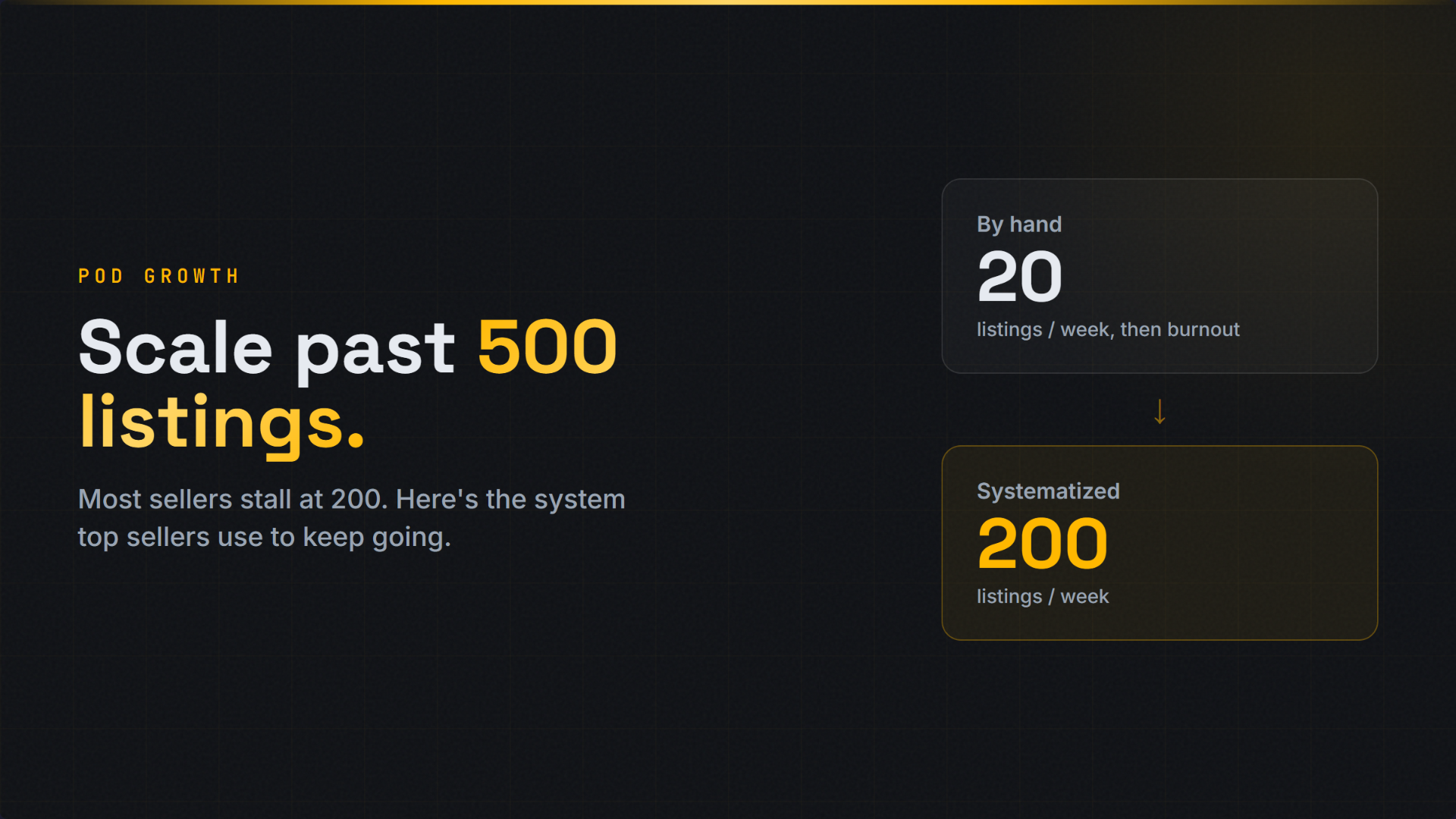
Most print on demand sellers hit a wall somewhere around 200 listings. Not because they run out of ideas - because the manual workflow that got them there cannot carry them further. Here is the system top sellers use to push past 500 and keep going.
Quick answer
Scaling past 500 listings is not about working more hours - it is about changing the workflow. The sellers who get there do five things: they batch their work instead of doing it one listing at a time, build a reusable template system, diversify beyond t-shirts into higher-margin products, sell on multiple platforms, and automate the bottleneck (mockups and listing). Top sellers run 1,000 to 5,000+ designs this way.
Why 200 listings is the wall
Most sellers build their first few hundred listings the same way: one at a time, by hand. Design, open Photoshop, make the mockups, write the listing, upload. Repeat.
That workflow works fine at 50 listings. It is painful at 200. It is impossible at 500.
The math is brutal. Uploading 100 designs to a marketplace manually takes about a week of work. Do that a few times and you burn out before you scale. The sellers who break through to real income - $5,000, $10,000, $20,000+ months - are almost always the ones who stopped doing it by hand.
The difference is not talent or better designs. It is the system. Bulk publishing and automation are what separate listing 20 products a week from listing 200.
The 5 levers that actually scale
You do not need all five at once, but you need most of them to get past 500. Here they are, in order of impact.
1. Batch everything
Stop working one listing at a time. Batching means doing each type of task in bulk: design a batch, generate all the mockups at once, write all the listings in one session, upload them together.
Context-switching between design, mockups, and copywriting for every single product is where the hours disappear. When you batch, you do the same task on repeat, get into a rhythm, and move far faster. A morning of focused mockup generation beats a week of doing them one at a time between other tasks.
2. Build a template system
The sellers who scale do not reinvent the wheel for every product. They build reusable systems:
- Mockup templates you use across every design (your own PSDs, so your shop looks consistent and on-brand)
- Listing templates with your title structure, tag sets, and description framework
- A naming convention so files map cleanly to listings
Build the template once, reuse it forever. This is the single biggest leverage point - a good template system turns a 10-minute-per-product task into a 30-second one.
3. Diversify your products
If your whole shop is t-shirts, you are competing in the most saturated, lowest-margin category in POD. T-shirts hold the largest market share but the thinnest net margins - typically 15 to 20 percent after fees and shipping.
Scaling is not just more listings. It is more kinds of listings. The same design can become:
- A mug or tumbler (40 to 45 percent margins)
- A wall art print (home decor is the fastest-growing POD category)
- A tote bag, a sticker pack, a phone case
One design, many products. You multiply your listing count and your margins at the same time, without designing anything new.
4. Sell on more than one platform
Single-platform sellers leave an estimated 70 to 80 percent of their potential revenue on the table. Every marketplace has a different audience with different buying intent. The same design can sell to completely different buyers on Etsy, Shopify, Amazon, and TikTok Shop.
You do not have to launch everywhere at once. Add one platform at a time. But a design that is already made is a design you can list in three more places - that is free scale from work you have already done.
The catch: each platform wants its own mockups and image sizes. Which brings us to the last lever.
5. Automate the bottleneck
For most sellers, the bottleneck is not designs or products. It is mockups. Every new listing, every color, every platform needs its own images. Done by hand, that is the task that caps your growth.
This is where automation changes the math. Instead of making mockups one by one, you generate them in bulk: one design across every template and color, hundreds at once, exported at the right resolution for each platform. The task that used to take a week takes an afternoon.
That is exactly what MockItReal does. Upload your designs, pick your templates, and generate unlimited mockups in 1-2 seconds each. Bulk batches, color variants, and the right export size for every marketplace. The mockup bottleneck stops being the thing that limits how many listings you can ship.
The listing-velocity math
Scaling comes down to one number: how many quality listings you can ship per week, consistently.
- Manual workflow: ~20 listings/week before burnout
- Systematized + automated: 200 listings/week is achievable
A realistic ramp: aim for 5 to 10 new listings a week in your first months, then increase as your system tightens. Consistency beats bursts. Ten listings a week, every week, is 500 listings in a year. Forty a week gets you past 2,000.
Most successful Etsy sellers report that consistent sales begin around 50 to 100 optimized listings. Past 500, you are in serious-business territory - and that is only reachable with a system.
Common scaling mistakes
| Mistake | Fix |
|---|---|
| Doing everything one listing at a time | Batch each task type |
| Rebuilding mockups for every product | Reusable template system |
| Only selling t-shirts | Diversify into higher-margin products |
| Staying on one platform | Add platforms one at a time |
| Hand-making every mockup | Automate bulk generation |
| Chasing volume over quality | Ship consistent, quality listings weekly |
FAQ
How many listings do I need to make real money on POD?
Consistent sales typically begin around 50 to 100 optimized listings. To reach serious income, top sellers run 1,000 to 5,000+ designs across multiple platforms. Quality and consistency matter more than raw count.
Why do most POD sellers stall around 200 listings?
Because the manual workflow that builds the first 200 - designing, making mockups, and listing one at a time - does not scale. Past that point, you need batching, templates, and automation, or you burn out.
What is the fastest way to add more listings?
Reuse what you have made. Put the same design on more products (mug, print, tote) and list it on more platforms. One design can become a dozen listings without any new design work.
How do I make mockups fast enough to scale?
Generate them in bulk instead of one at a time. With a tool like MockItReal you can produce hundreds of mockups from one design in minutes, exported at the right size for each platform.
Should I sell on multiple platforms?
Yes. Single-platform sellers leave an estimated 70 to 80 percent of potential revenue on the table. Add platforms one at a time once your system can handle the extra listings.