Lifestyle vs flat mockups: which actually sells more?
Every POD seller eventually asks it: should my mockups show the product on a clean background, or styled in a real scene? The data has a clear answer for most products, a surprising exception for a few, and one move that beats picking either.
Quick answer
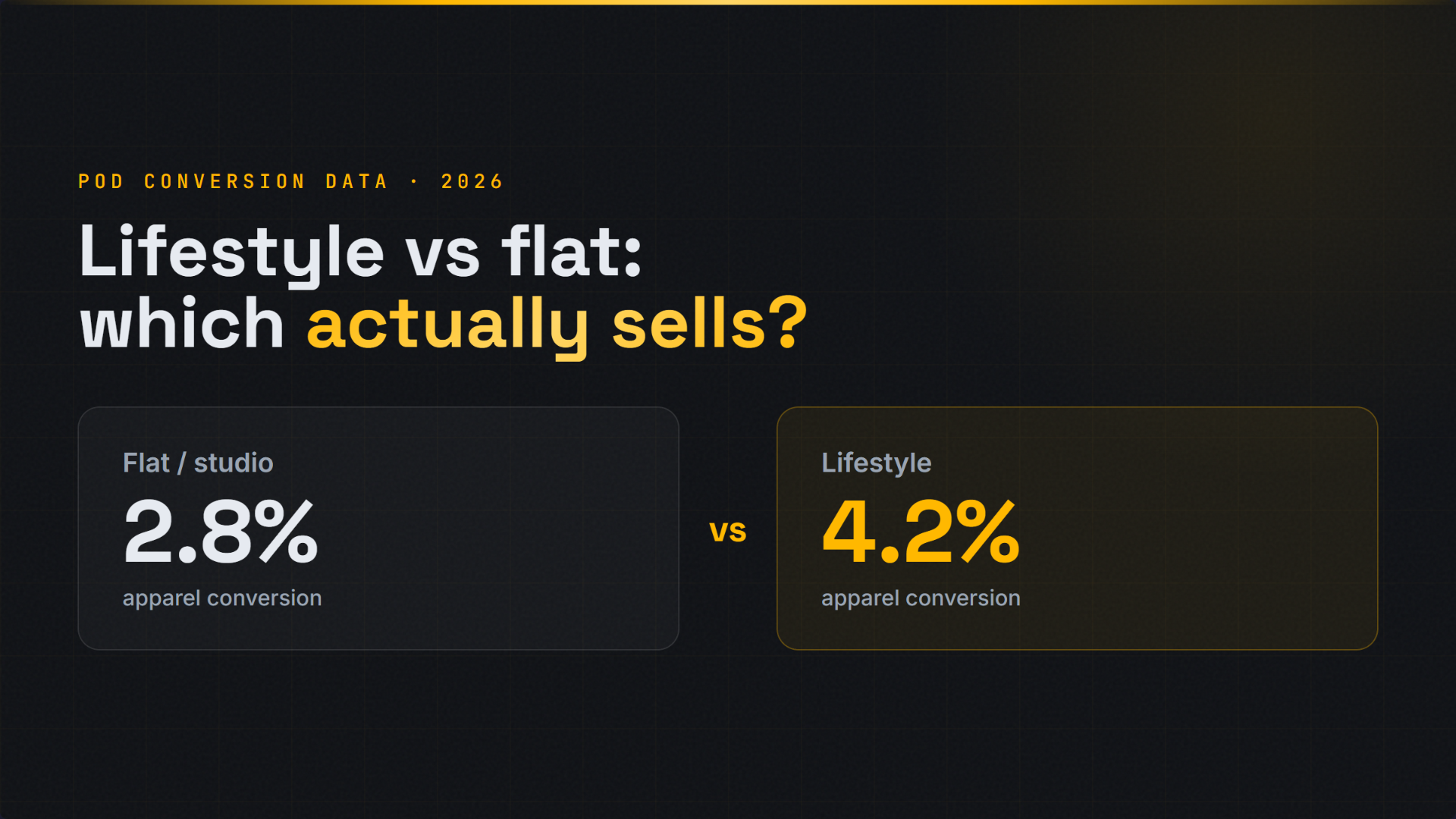
For most POD categories, lifestyle mockups convert better than flat ones. Apparel converts at 4.2% with lifestyle images versus 2.8% with studio shots. But it is not universal - some categories (and Amazon's main image) do better with a clean background. The highest-converting approach is to use both: pages with lifestyle and studio images together see a 30% conversion uplift (eMarketer).
What "lifestyle" and "flat" actually mean
Flat (studio) mockup: the product on a clean, often white or neutral background. Clear, distraction-free, shows the product accurately. This is the classic catalog look.
Lifestyle mockup: the product placed in a real or styled context - a t-shirt on a person, a mug on a desk, a print on a wall. It helps the buyer imagine owning and using the product.
Both have a job. The question is which one sells more, and the honest answer depends on what you are selling.
The data: lifestyle vs flat by category
Conversion rates vary by product type. Here is the verified 2026 data:
| Category | Studio (flat) | Lifestyle | Winner |
|---|---|---|---|
| Fashion & Apparel | 2.8% | 4.2% | Lifestyle |
| Home Decor | 2.4% | 3.8% | Lifestyle |
| Sports Equipment | 2.7% | 4.1% | Lifestyle |
| Beauty Products | 3.1% | 3.7% | Lifestyle |
| Electronics | 3.6% | 2.9% | Studio |
Source: category conversion data, 2026 ecommerce benchmarks.
For the products most POD sellers make - apparel, home decor, accessories - lifestyle wins, and often by a wide margin. Apparel lifestyle images convert 50 percent better than studio shots (4.2% vs 2.8%).
But notice electronics: there, the clean studio shot wins. That is the exception worth understanding.
Why lifestyle wins for most products
Three reasons, all backed by data:
- Buyers spend more time looking. Customers spend 73 percent more time viewing lifestyle images than studio shots - a sign of higher interest and emotional engagement.
- It helps them imagine owning it. A shirt on a person or a print on a wall answers "what will this look like in my life?" in a way a flat image cannot.
- It builds trust through context. Seeing scale, setting, and styling makes the product feel real and reduces hesitation.
There is a returns benefit too. McKinsey's customer analytics found that improved imagery reduces return rates by 23 percent, because buyers have accurate visual expectations before they purchase.
When flat (white background) wins
Do not throw out the clean shot. It wins in specific situations:
- Technical or detail-driven products (the electronics example) where buyers want to see the product clearly, without distraction.
- Amazon's main image - this is not a preference, it is a rule. Amazon requires the main image to have a pure white background with the product filling at least 85 percent of the frame. Your lifestyle shots go in the secondary slots.
- The first impression in search. A clean, instantly-readable thumbnail can earn the click; the lifestyle shots then close the sale on the listing page.
So flat images still have a clear role - usually as the lead or the technical reference, with lifestyle doing the emotional selling.
The factor bigger than style: resolution
Here is the thing most sellers miss. Before you even get to lifestyle vs flat, image quality matters more than style.
High-resolution product photos convert 94 percent better than low-resolution ones - one of the most consistently cited findings in ecommerce research. Products shot with professional-quality imagery convert up to 40 percent higher than amateur shots (Statista, 2025). Simply upgrading from 1000px to 2000px images produces a measurable 5 to 15 percent conversion lift.
In other words: a sharp, high-resolution flat mockup will outsell a soft, low-resolution lifestyle one. Get the quality right first, then optimize the style.
The real answer: use both
The single highest-converting approach is not choosing lifestyle or flat. It is using both.
E-commerce product pages that combine lifestyle and studio photography see a 30 percent uplift in conversion rates on average (eMarketer). The clean shot shows the product accurately. The lifestyle shot makes it desirable. Together they answer every question a buyer has.
Practically, for a typical POD listing:
- Image 1: clean, high-res flat mockup (and the required white-background main image on Amazon)
- Images 2-4: lifestyle scenes - the product in context, different angles, styled
- Images 5+: detail crops, color variants, size or fit references
Most platforms give you multiple image slots. Etsy allows 10. Use them. Listings with more high-quality images consistently convert better.
How to make both without a photographer
The old objection to "use both" was cost. Lifestyle photography meant a studio, a model, a shoot - for every product and every color.
That is no longer true. With MockItReal you generate both from the same design: a clean flat mockup and a styled lifestyle scene, using your own templates or AI-generated backgrounds. No photographer, no shoot. Make unlimited versions, export each at listing resolution, and fill every image slot on every listing.
The data says use both. The tooling finally makes that practical at scale.
FAQ
Do lifestyle or flat mockups convert better?
Lifestyle mockups convert better for most POD categories - apparel converts at 4.2% with lifestyle versus 2.8% with studio shots. The exception is technical products like electronics, where clean studio images win. The best results come from using both: combined, they lift conversion by about 30%.
Should I use lifestyle images on Amazon?
Use a clean white-background image as your main image (Amazon requires it), then use lifestyle shots in the secondary slots. You get the best of both within Amazon's rules.
Does image quality matter more than style?
Yes. High-resolution images convert 94% better than low-resolution ones regardless of style. Get the resolution right first (2000px+ for listings), then optimize lifestyle vs flat.
How many images should a POD listing have?
Use as many high-quality slots as the platform allows - Etsy gives you 10. A clean main shot, several lifestyle scenes, and detail or variant crops consistently outperform listings with only two or three images.
Can I make lifestyle mockups without a photographer?
Yes. AI-generated scenes and your own styled templates let you create lifestyle mockups without a studio or model. Generate both flat and lifestyle versions from the same design.
Sources
- Category conversion data & 30% combined uplift: eMarketer ecommerce product page analysis
- 40% professional vs amateur lift: Statista 2025 ecommerce benchmark report
- 23% return reduction: McKinsey customer analytics
- 94% high-res vs low-res; zoom/resolution lift: ecommerce product photography research (Amazon listing guidelines)